
- 40% of inbound calls automated end-to-end
- Weekend callers reach resolution without waiting for Monday callbacks
- Pair reduced seasonal hiring pressure during peak holiday volume
- Custom Flip reporting now feeds directly into Pair’s forecasting models
Nathan Kondamuri had worn glasses since he was eight years old.
Growing up, he hated it. At that time, glasses meant a single, static, medicinal-looking frame that announced itself as a necessity rather than a choice.
When he met Sophia Edelstein at Stanford in 2014, they started asking a simple question together: why couldn’t glasses work like shoes, jewelry, or any other accessory that lets people decide who they want to be that day?
From that question, and from interviews with more than 400 families, Pair Eyewear was born in 2017.
The concept is elegant and simple: a prescription base frame and a collection of interchangeable magnetic top frames that snap on and off in seconds. New collections drop nearly every week. Licensed designs from Marvel, Disney, MLB, and Harry Potter sit alongside bold originals.
The product struck a nerve. After a Shark Tank appearance in 2020 that landed deals with Lori Greiner and Katrina Lake, the company experienced 10x year-over-year growth, with some customers owning hundreds of top frames.
That enthusiasm extends beyond the product itself. An 82,000-member Facebook group called “The Pair Fam” emerged organically from the customer base.
That organic loyalty is the foundation of everything Pair does. But it also creates a real operational challenge: when people love your product that much, they want to reach you when something goes wrong – not when it’s convenient for your call center.
MONDAY MORNING MADNESS
For all of Pair’s momentum, their customer support operation had a ceiling built into it. Phone lines closed at 6 PM Eastern on Fridays, and stayed dark throughout the weekend. Anyone who called in after hours heard a voicemail prompt, left a message, and waited to hear back on Monday morning.
Jeff Rybicki, who manages Customer Experience Operations, recalls what those Monday mornings looked like: “We’d come in to dozens and dozens of voicemails that all needed call-backs, and we still needed to be there for customers as they called in.”
The deeper issue was structural. Pair’s agents were primarily dedicated to the phone channel, which made it harder to have capacity across support channels as demand shifted. When volume spiked, the solution was often to add headcount. The holiday surge for Black Friday and Cyber Monday meant hiring and quickly training a class of temporary agents, then scaling back shortly after.
“We’re not a massive company,” Rybicki explains. “We always do a relatively large ramp-up in the holiday period, but we want to hire folks we can train and keep on board. If the class is smaller, that’s a more sustainable goal.”
Meanwhile, data showed that customers didn’t always observe Pair’s business hours when they had questions. People called on Saturday nights. They called at 11 PM. They called on Sunday mornings. But support, as it was structured, couldn’t extend to meet them there.
THE RIGHT CONVERSATION AT THE RIGHT MOMENT
“Sometimes the best conversation is that conversation you’re not expecting at the coffee shop or in the airport – it just kind of works out.”
The path to Flip started the way the best business relationships often do: through a chance encounter. At an event in New York City, Pair’s Director of Customer Experience Strategy and Operations Zachary Headapohl ran into the Flip team. They started talking about what Voice AI could look like at Pair, and the conversation didn’t stop.
A few calls later, Rybicki was brought in, and what he saw in the early demos surprised him.
“There’s some natural skepticism around AI tools in general because they have this kind of negative connotation in customer service,” he acknowledges. “If I call somebody and I get an AI bot, I’m like, ‘This might not go well.'”
But Flip’s demos were different.
“The responses were a lot quicker in a lot of cases than anything else we had demoed, and they sounded more natural. We also had the ability to do a little bit of light scripting. Seeing that in practice, and doing test calls ourselves, kind of assuaged any concerns on our side.”
The decision wasn’t driven by fear of being left behind, or by a mandate to adopt AI. It came down to something simpler: the product worked, and the team behind it felt like a long-term partner.
Today, Rybicki works closely with Stephen Kelly and Sophia Velo to drive operational results with Flip.
“We work well organically,” he says. “Stephen, Sophia, and I talk all the time. The whole team hit it off very well with each other.”
FAST, FLEXIBLE, AND FIXATED ON A MOVING TARGET
If there were any nerves heading into implementation, the process dissolved them. Soon after onboarding Flip, Pair began migrating their help desk. That kind of parallel transition is where implementation projects typically fall apart.
This one didn’t.
“Flip was very good about moving between platforms,” Rybicki recalls. “I was really impressed while I was doing the implementation, we were able to get a lot of help on the Flip side to get things moved over. That was very smooth.”
Part of that easiness was structural: voice services running through the same software on both sides meant one less point of friction. But it was also a function of the Flip team’s responsiveness. The new helpdesk uses a task-based model that’s distinct from how most helpdesks work – a genuinely different architecture that other vendors might have treated as an edge case. Flip treated it as something to solve.
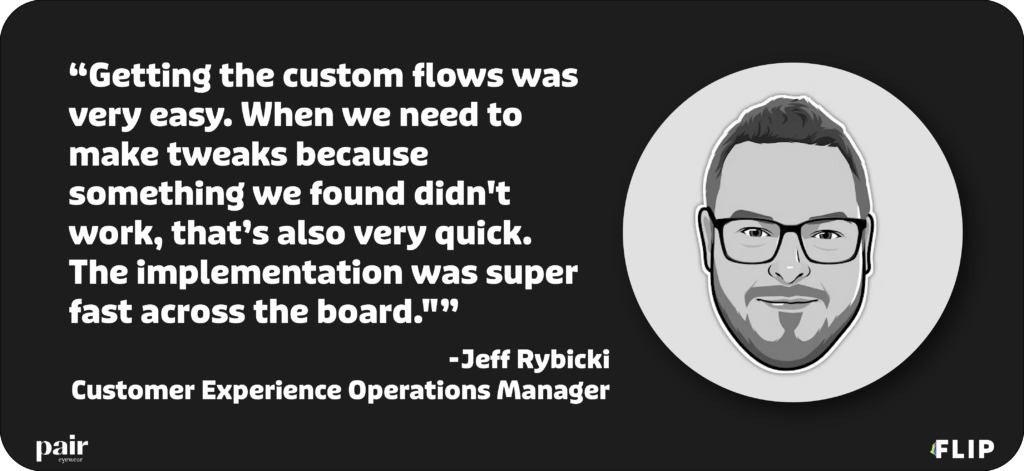
“Getting the custom flows was very easy. When we need to make tweaks because something we found didn’t work, that’s also very quick. The implementation was super fast across the board.”
For Rybicki specifically, the data layer mattered as much as the voice layer. He’d spent years building forecasting models and wasn’t about to let a new platform break them. He worked with the Flip team to build custom weekly reports that feed directly into his models without requiring manual reformatting.
“I was able to work with Stephen to get a bunch of custom reports right down to exactly which columns and in which order I needed them to be in, and then get them scheduled,” he explains. “Now every week I get all of the volumes from the previous week with the custom columns I need to plug into my model. That lets me continue forecasting appropriately without having to jump through hoops.”
It’s that kind of attention to detail that makes all the difference in daily operations.
40% AUTOMATED. ZERO VOICEMAILS.
Roughly four in ten inbound calls to Pair are now handled by Flip end-to-end, with no agent, no callback, and no second touch.
For Rybicki, the real signal isn’t just automation. It’s what happens next.
“Anytime Flip is able to handle a call, start to finish, full automation, and then there’s no subsequent outreach from the customer, it’s a big win on our side,” he says. “That’s the metric that tells me customers got what they needed.”
On weekends, when there are no agents available, automation rates climb even higher. Customers who might otherwise have gone to voicemail or given up entirely are now reaching resolution without ever speaking to a human. For a brand whose customers care deeply about their orders and the next drop, that availability is meaningful.
The workforce impact has been just as significant. Because Flip absorbs a reliable percentage of inbound volume, agents have room to breathe. They can be shifted to asynchronous channels and handle complex escalations without the pressure of a backed-up queue. If genuine operational crises emerge, the team has the capacity to address it.
The holiday season tells the story most clearly. Pair historically ran a large seasonal ramp, and last year, that class was smaller. Not because fewer customers reached out, but because Flip absorbed enough volume to make it manageable.
As for the customers themselves? Most of them don’t seem to notice – or, if they do, they don’t particularly mind. “For the most part,” Rybicki says, “the conversations are organic whether the customers realize they’re talking to a bot or not. They just keep the conversation going, get the information they need, and say thank you and move on.”
“The very fact that it’s not immediately apparent – that’s good. It speaks volumes to their trust in the platform.”

THE SOLUTION IN ACTION
Twice, Flip became something more than a tool. It stepped in as an extension of the team.
The first came when a major earthquake struck the Philippines, disrupting transit and preventing Pair’s offshore CX team from getting into the office. It was the middle of the night Eastern time, which meant the team on the ground was dealing with downed infrastructure while agents on the other side of the world were asleep.
“I was able to put up a temporary closure message, test it, refine it, and make sure nothing was hitting our voice channel – almost immediately. That ability to move quickly on something operational and trust it works is my favorite part of Flip.”
The second moment, in its own way, was just as revealing. During the holiday season, when orders were going well, the team had an hour off for a party. No one on the phones. No skeleton crew. Just a full team celebration.
He closed the queue, put up a message, and thought carefully about what it should say.
“I put up a message saying, ‘Hey, we’re celebrating with the team. We’ll be back in about an hour.’ It’s a simple way to be transparent with customers while also giving the team that time – and making sure no one’s confused when we’re offline.”
It’s a small moment, but it illustrates something important: when a tool is genuinely trusted, it stops being used defensively.
Pair doesn’t use Flip to patch gaps; they use it to give their team more humanity, not less.
AUTOMATION IS THE FOUNDATION
When a handful of vendors tried to pitch alternate voice agents to Pair, the answer was immediate: don’t bother. Flip isn’t going anywhere.
“Bluntly,” Rybicki says, “because of how easy Flip has been to work with, we’re in it for the long haul.”
That confidence is the result of watching an effective product become woven into the daily rhythms of an operation. The custom task flows, the Gladly integration, the weekly scheduled reports, the intent-driven improvements that Flip’s team surfaces proactively – all of it has made voice automation feel less like a vendor relationship and more like infrastructure.
“We’ve been able to build so much of our custom task work that we’d have to completely rethink phones as a channel if we weren’t using Flip,” Rybicki explains. “Phone automation is never going to go away. If anything, it’ll ramp up more.”
The goal he names isn’t transformational. It’s precise: “Let’s get to 42% next year. Make the number go up ever so slightly.”
That kind of measured ambition is exactly the disposition that makes automation sustainable.
“You’ve made it so that the Flip piece is an integral part of our business. It’s our normal day-to-day for phones at this point.”
Not chasing a ceiling. Just accelerating, consistently, with a partner like Flip that’s built to do the same.