
Sam Cohen does not like saying “no.”
As Director of Customer Experience at Kitsch, his job is to make things easy – for customers, for his team, and for the business. Whether someone is replacing a product, editing an order, or asking for help, the goal is always the same: remove obstacles wherever possible.
For a fast-growing beauty brand with a loyal customer base, that philosophy works – as long as you can keep up with the phones.
KEEPING UP WITH THE PHONES
Phone calls don’t wait their turn.
As Kitsch grew, even routine support requests started stacking up. Every call demanded an agent’s full, undivided attention, which meant every call pulled someone away from everything else.
“Phone calls can take a disproportionate amount of time,” Sam explained. “You’re spending significant attention on one customer while a lot of other people need help at the same time.”
Hiring more staff was always an option. But demand doesn’t arrive evenly – it spikes, then drops, then spikes again. Predicting exactly how many agents would be needed, and when, was its own full-time problem.
“We’d try to forecast accurately,” Sam said. “But if we’d miss the mark, we’d fall behind.”
Sam was also skeptical of AI. He had seen what it usually took – tools built from scratch, systems requiring constant monitoring, automations that worked, until they didn’t.
His bar was blunt: “A piece of software is succeeding if I never hear about it. If it’s working, I don’t need to think about it.”
SIX DAYS TO A DEAL
Flip entered the picture during a busy season – stretched capacity, climbing call volume, and no clean way to get ahead of it.
Kitsch saw the value instantly, and the deal closed in six days. The rollout was fast. The impact was faster.
“It basically gave us unlimited capacity in that channel,” Sam said.
For the first time, Kitsch’s support team didn’t have to plan around how many calls they could physically answer. Flip absorbed volume as it came, handling routine requests while integrating with existing systems like Shopify, Gladly, Skio, and Loop.
The difference played out visibly over 2025. In June, the phone channel handled 315 calls. By July, that number had grown nearly fivefold. November hit 3,200 inbound calls – a 40% year-over-year increase from 2024.
The phones got busier. The response time stayed the same – with Flip automating over 70% of calls.

SELF-SERVICE SOLUTIONS
Capacity wasn’t the biggest shift. Flip also gave customers something they’d never had before: the ability to solve problems themselves, instantly, over the phone.
Before Flip, there was no way for a customer to cancel an order through Kitsch’s existing portals without reaching out to support. If someone called to make a change, they waited for an agent. And at Kitsch, waiting has a cost.
“We have about an hour after an order is placed before it moves through the next system,” Sam explained. “After that, changes become much harder and sometimes aren’t possible.”
That window could close before a customer reached an agent.
Flip changed that. Customers can resolve their issues (cancel an order, make a change, resolve an issue) in seconds, regardless of volume.
“We were able to let customers take actions through the phone that they couldn’t self-serve anywhere else,” Sam said.
For some customers, navigating a portal is simple. For others, even basic interfaces create friction. Flip created another path, one where the process was intuitive for everyone regardless of their technical acumen.
“Callers can resolve requests in thirty seconds or a minute,” Sam said. “That’s where customers are most surprised.”
WHAT THE TEAM GOT BACK
As Flip handled the routine, the work inside the team changed.
Agents stopped spending their time editing orders and answering the same questions in rotation. They started working on complex issues that actually required human judgment.
“Now our team can focus on things that really require investigation,” Sam said.
Flip’s dashboard also gave the team something they hadn’t had before: clarity. A direct line of sight into why customers were calling, what they were trying to do, and where existing processes had gaps.
“It’s been very easy to see what customers actually want to achieve when they call,” Sam said. Those insights have since shaped how Kitsch has expanded its policies, workflows, and automation over time.
And through all of it, the most noticeable thing about Flip was how little anyone had to think about it.
“It pretty much never breaks,” Sam said.
For someone who came in skeptical, that was the test. Flip passed with flying colors.
THE FUTURE IS PHONE AI
It’s easy to think of customer support automation as a convenience. At Kitsch, it’s something more.
Without Flip, “Customers weren’t always able to reach us in the window where orders could still be edited,” Sam said. Customers would receive products they intended to cancel. Returns would follow, along with additional time and cost. By resolving those requests immediately, Flip doesn’t just improve the experience. It prevents problems before they are created.
Today, Kitsch uses automation across messaging, social, and phone – and Flip handles the moments where timing matters most.
Sam sees more ahead. “The future would be covering even more of the calls coming in,” he said.
He still approaches AI the way he always has: cautiously, practically, focused on what actually works. Flip met that standard. And now, it’s raising it.
For teams figuring out where to start, his advice is simple:
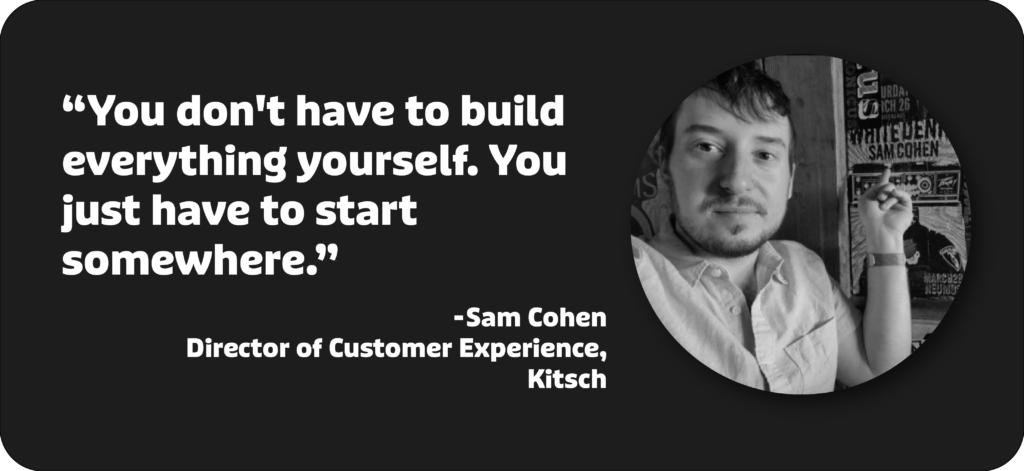
“You don’t have to build everything yourself. You just have to start somewhere.”
For Kitsch, that “somewhere” was the phone, and the answer was Flip.