
- Eliminated peak-time bottlenecks with abandonment down to 3–4%
- Automated resolution for ~35% of total call volume
- Enabled one system to support four brands with consistent product expertise
Scale Media was not supposed to have a phone problem.
The Beverly Hills–based company had already cracked the code to building consumer brands. Since 2013, it had grown four distinct direct-to-consumer businesses: 1MD Nutrition, Live Conscious, Tru Alchemy, and Essential Elements.
Each brand serves its own customers, products, and expectations. Together, those four brands have produced over $1 billion in sales and over 20 million orders.
And like any business operating at that level, the most important moments weren’t always on the website.
They happened on the phone.
The Problem No System Could Handle
The issue wasn’t volume.
It was timing.
Demand arrived in waves – predictable, but unforgiving. Monday mornings, especially after weekends or holidays, compressed an entire day’s calls into a few hours. The team would absorb the surge as best they could, but inevitably, customers waited. Some hung up.
At peak moments, abandonment rates climbed into the 20%-30% range.
By the afternoon, the pressure lifted. The same system that had been overwhelmed just hours before would sit overstaffed, calibrated for a spike that had already passed.
There was no clean way to reconcile the two.
Scale Media had already consolidated vendors, streamlined systems, and brought their phone infrastructure under one umbrella. It improved visibility and coordination, but it didn’t move the needle on the underlying constraint. The phone channel could not expand and contract with demand, and no staffing model could fully absorb that variability without creating inefficiencies somewhere else.
Michael Furman, Senior Director of Customer Experience and Call Center Operations, lived inside that tension every day. His team was lean by design, built to operate efficiently across four brands simultaneously. That efficiency came at the cost of flexibility. When volume spiked, there was no buffer. When it dropped, there was no way to reallocate the time.
“With four brands,” Michael says, “it’s always challenging to find the right balance between the best technology and the best customer experience for my team.”
The math was clear, even if the solution wasn’t: the phone channel had to absorb the variability that the team no longer could.
The First AI Attempt Was A Lesson Learned
The answer, on paper, was AI. Scale Media pursued it, and encountered a solution that looked right until it came out of the box.
“We had tried an AI solution previously that failed. We didn’t know what we didn’t know,” Michael explains. “And in the learnings that we had there, we realized we have some different questions we need to ask.”
It wasn’t a question of bad intentions. It was a question of fit, and of what happens when implementation ends and partnership doesn’t begin. When questions came up, they stayed unanswered. When the system needed to adapt, it couldn’t. The ROI that had been projected never arrived.
What did arrive was clarity. The experience gave Michael’s team a precise understanding of what they actually needed – not just a capable product, but a team that would stay in the work with them.
“As we started to vet out other options, it became glaringly apparent that the relationship was going to be the focal point of our success and willingness to work together to achieve our goals.”
When Scale Media went looking again, they knew exactly what they were looking for.
Flipping The Script
Michael’s team wasn’t looking to be impressed. They were looking for evidence that someone understood the difference between a working demo and a working product.
Flip passed that test in an unexpected way.
Rather than leading with polished success stories, Flip’s team shared real calls from real deployments. It was a quiet signal, but a significant one. The system wasn’t being presented as finished, but as something that could be shaped, adjusted, and built around Scale Media’s specific needs.
“They showed us they were willing to say, ‘Hey, we make mistakes as well.’ And once we had that comfort level, the relationship that we built – it was very easy for us to go ahead and realize that we had a business partner, not just a vendor.”
What Scale Media found wasn’t a vendor managing their expectations – it was a team willing to work through the hard parts with them.
Senior Customer Success Manager Jeff Robie joined as their primary operational partner, and that dynamic held throughout the engagement. Michael is quick to note that Jeff’s strengths are better suited to customer success than to the basketball court – but on the implementation side, there were no complaints.
“My team leaned on Jeff heavily, and he was perfect in guiding us down that process,” Michael says. “There were times where he gave us information, and times where he gave us the tools to learn on our own. In doing so, it gave us more confidence as we moved forward.”
The relationship that took shape wasn’t transactional. It became something Michael describes in terms most vendor conversations never reach.
“It’s not ‘you work for us and we work for you.’ We work together to achieve our goal.”
Building One Intent At A Time
Every AI vendor will push “Where is my order?” as the natural starting point. Michael’s data told a different story.
Fewer than 2% of Scale Media’s inbound calls were order-tracking inquiries. Their customers were calling about the products themselves – and across four brands, those product questions spanned serious ground. From the clinical rationale behind a physician-formulated supplement to how a Tru Alchemy serum interacts with sensitive skin, the answers required genuine depth with confidence.
“With Flip, we were able to put all of that content in and get solutions for our customers in a timely fashion, which helped out with average handle time, but more importantly, the customer experience,” Michael explains. “There is a very polished and expert feel when we share that information.”
Flip gave Scale Media a way to put their product knowledge directly into the voice experience – coded in, consistent, and immediately available regardless of which brand a customer was calling about. The effect was immediate.
“There wasn’t hesitation, there wasn’t pause. It gave us a chance to really change that customer experience and give them confidence in purchasing from us,” Michael says.
The rollout was deliberate. Scale Media launched on their smallest brand first, working through lower-stakes intents before moving to higher-stakes ones. Each win funded the next – adjusting voice timing, refining individual call flows, expanding coverage only when the team was satisfied with what they’d built. Subscriptions and cancellations came last.
“We took those smaller wins, really perfected what we were doing—everything from changing the voice to changing the timing—and used the momentum from those small successes to make them much larger. So once we hit those larger intents, we didn’t have those stumbles along the way.”
Some intents went live in hours. Others intentionally took longer. The pace was theirs to set, and that control mattered to a team that had been burned before.
“One of the things that’s really unique about Flip is you can go as fast as you want, but you can also take your time. It’s really your comfort level and your organization’s comfort level to find that happy medium.”
What started as careful steps on a single small brand became a multi-brand implementation that the team owned.
A System Transformed
The numbers tell the clearest part of the story.
Abandonment rates that had once peaked at 20–30% during high-volume periods fell to 3–4%. Approximately 35% of calls are now fully handled by Flip – not routed to a human, not escalated. Resolved.
The staffing trap that had defined Scale Media’s contact center for years dissolved: Monday morning surges could be absorbed without emergency scheduling, and volume spikes no longer demanded a proportional response on the labor side.
Internally, the shift was just as visible. Agents spent less time searching and more time on the conversations that actually required them. The team didn’t need to grow to keep up with demand and didn’t need to overcorrect for it when demand eased.
And because the system was built iteratively, those gains didn’t plateau. Each new workflow added coverage. Each refinement improved accuracy. What started as a narrow set of use cases expanded into something that handles a meaningful share of total call volume without sacrificing the quality those four brands were built on.
This Time, It Holds
“Be a sponge in the beginning,” Michael says. “Absorb as much as you can. And as you learn, start to question what’s being presented as fact.”
It’s how he approaches every vendor now – past the demo, into what actually happens once the system is live.
“Of course it’s going to look wonderful. But that’s not your production. You have to ask: what happens when this changes? What happens when something breaks?”
That standard didn’t exist the first time. Now, it defines how they evaluate everything that follows, including why they continue to build with Flip.
“There’s no goal line. It’s not like you get there and you’re done. It’s always a process where you’re going to continue to learn – and Flip has done a great job of helping us understand that.”
For a company whose brands depend on earning trust month after month, the phone has always been where that reliability is either reinforced or lost.
Michael puts it more simply than any metric could:
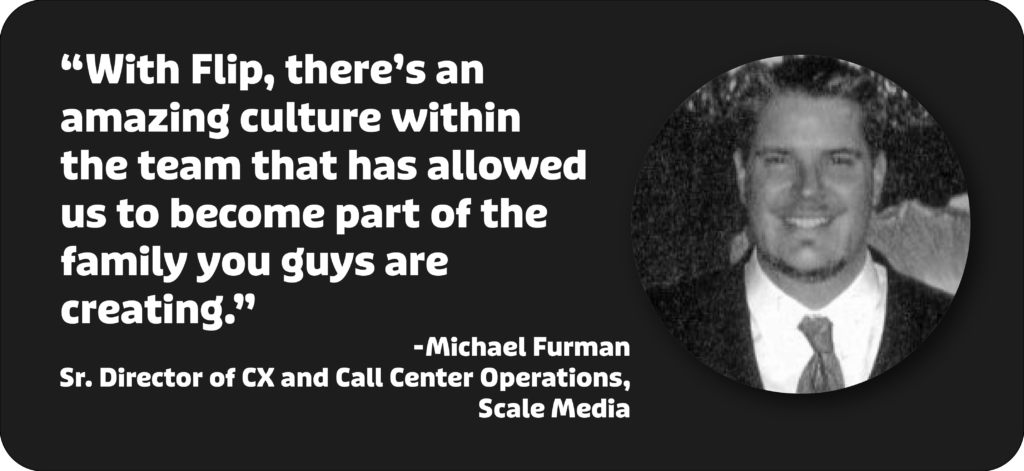
“People throw around the cliché that it feels like a family,” Michael says. “But with Flip, there’s an amazing culture within the team that has allowed us to become part of the family you guys are creating.”