
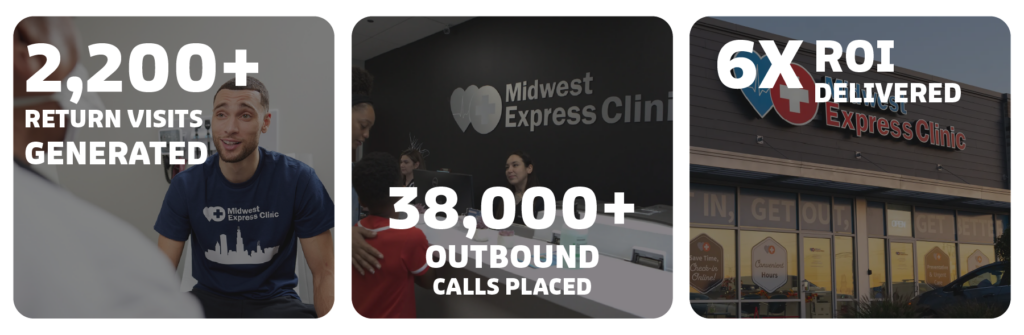
- 38,000+ outbound aftercare calls placed in the first 45 days, reaching more than 18,000 patients across 55 locations
- 2,200+ return visits generated by helping patients who felt the same or worse rebook in real time
- 6x return on investment delivered, while improving visibility into the full post-visit patient journey
- CSAT increased nearly 10%, with NPS increasing by 2 points, as patients experienced more proactive follow-up care
Midwest Express Clinic has never been content to be just an urgent care, and Ryan VanHolsbeke had a plan to make that philosophy tangible.
The vision was that every patient who walked out of one of their 55 locations would get a phone call three days later. Not a survey text, not an automated nudge – a real conversation. Are you feeling better? Do you need to come back in?
As Director of FP&A, Ryan explains that: “We’re trying to change the nomenclature and be more of a one-stop shop for people, whether it’s that episodic urgent care visit or acting as a primary care for patients who may not have a primary care physician.” For a clinic owning continuity of care, a three-day follow-up call was more than a nice feature. It was the whole philosophy, made practical.
Before Flip, however, the dream was nearly impossible to execute.
Across 55 locations, hundreds of patients a day, and a finite number of provider hours, the math was useless. Providers worked the calls in when they could, but it couldn’t occur at a meaningful scale. “Providers get busy. Clinics are busy,” he said. “The first thing that falls is that follow-up phone call.”
And without a system behind it—no tracking, no follow-through, no way to close the loop—there was no clear picture of what was being lost. The idea would surface, fail to gain traction, and quietly recede.
“Hit and miss is very generous,” Ryan said. “If this had been a KPI, we would not have been performing well.”
It wasn’t a failed program, but without Flip, the vision was just that: a vision.
THE CONVERSATION THAT CHANGED THE EQUATION
For almost a year, Midwest worked with the Flip team on billing outreach and payment processing. Together, they built familiarity and, most importantly, trust.
Ryan had seen what Flip could do, and so he started to wonder what else it could handle. Suddenly, the aftercare call program felt possible.
“It really was a brainstorming session,” Ryan said. “The team at Flip are thought leaders in terms of things like this, and as we worked through the mechanics, it really was a true partnership in the development of this idea.”
Three days after a patient is discharged, Flip places an outbound call on Midwest’s behalf. At the center of the whole program, the call asks one question: are you feeling better, the same, or worse?
If the patient is doing well, the call ends there – no unnecessary hassle for someone who is already feeling healthy.
If the patient is still struggling, Flip helps them book a return visit using real-time appointment availability. Every interaction is then logged automatically in the patient chart, giving the clinical team a complete record without anyone having to pick up a pen.
The three-day window was deliberate: enough time for medications and treatment plans to take effect before asking the question. And the question itself, Ryan noted, is less a clinical protocol than a human instinct. “If your mom asks you, are you feeling better after you went to the doctor? This is stepping in and being that voice.”
On March 30, the program went live.
Flip’s Beylem Zanagar, the Client Success Manager on the case, explained that: “It was never about adding automation for automation’s sake. It was always with the intent of making sure the follow-up care you already really believed in could actually be happening at scale.”
WHAT 38,000 PHONE CALLS SOUND LIKE
When asked about the 38,000 outbound calls the program had placed in its first 45 days, Ryan didn’t lead with the stat. He described the alternative.
“If you thought about having somebody over the last 40 to 45 days calling 40,000 patients, that would be untenable to do. If you try to stand this up from a call center perspective, that’s just a lot of phone calls to make, and they’re not all a quick kill phone call.”
The program was taking on work that would have required an impossible amount of human time.
“There are tasks handled through voice AI that would take an army to complete effectively,” Ryan said. “You can leverage scale quickly, and take away tasks that would eat into provider time or administrative time.”
Of those 38,000 calls, more than 18,000 patients were reached – 75% feeling better, and 30% of those still struggling converting to a return visit, generating over 2,200 rebookings.The program has delivered a 6x return on investment.
Ryan is precise about what the 75% figure actually means. Flip calls every patient after every visit, and among the patients reached, three-quarters are recovering as expected. For a healthcare operator, having this data across 55 locations is not only quantitatively powerful for its measurability, but qualitatively impactful as well.
And for the 25% who aren’t yet better, the program doesn’t flag the problem and move on. It solves it. That 30% rebooking rate among the “same or worse” cohort is the highest conversion of any patient group Midwest Express tracks. The patients who most need to come back are the ones most likely to do so, because someone asked.
Patient satisfaction has tracked in the same direction. CSAT improved nearly 10% and NPS increased by 2 points. Ryan connects these numbers directly to the simple act of reaching out.
“Patients see that there’s care with it,” he said, “and that’s reflected in the CSAT and NPS scoring.”
The visibility has been as meaningful as the outcomes. For the first time, Ryan can trace the full arc of a patient’s post-visit journey: discharged, called, returned, seen.
“Being able to track from end to end that a patient walked out, they were called, they came back really just lends credence to why we’re doing it.”
Midwest Express Clinic carries a tagline: Healthcare with Heart. For Ryan, the aftercare program isn’t just a performance metric. It’s proof of concept.
“This is us showing that we do care about you as a patient,” he said. “When people feel that, it drives that repeat visit – not just at that singular moment three days after their visit, but down the road. They think of Midwest Express as someone they can come to that clearly has their best interest in mind.”
There’s also something in the 75% figure that Ryan finds meaningful beyond the operational. Knowing that the majority of patients who receive specific, targeted care are getting better isn’t just a business metric.
“It really shows that we are delivering the care that people need,” he said.
JUST THE BEGINNING
In May 2026, Midwest Express Clinic renewed with Flip for two years. Ryan explains this decision in terms of trust, and what it feels like to work with a team that moves at the same speed you do.
“This is a relationship that builds upon success,” he said. “We continue to try things. We may pull back on certain things, but it’s very much: let’s think about things in a different way, develop a different strategy, collectively work on strategic patient care, relationship building, retention. I truly believe it’s been a two-way street.”
That trust is already pointing toward what comes next. Midwest and Flip are developing new use cases and deepening integrations through Experity, the shared EHR platform powering both teams. Ryan thinks what Midwest has built may end up as a blueprint for the broader industry. “What we’re developing here is so effective that it can be base business for other people to start thinking about,” he said.
His advice to other operators? Don’t let the scale of the problem be the reason you don’t start.
“Whether you’re a small couple-clinic group or 100 clinics, there’s a solution that fits all shapes and sizes. Give it a try. The Flip team is very helpful in looking at the data, understand it, and make changes – working as a partnership to produce the best results possible. Take a long, good hard look at this.”
And if Flip were suddenly gone? Ryan didn’t pause. “Billing would be a problem. Patient outreach would be a problem. The initiatives we have going would cease to exist – because this is not something we could stand up internally. We would lose a lot of efficiency, or we’d just have to give it up.”
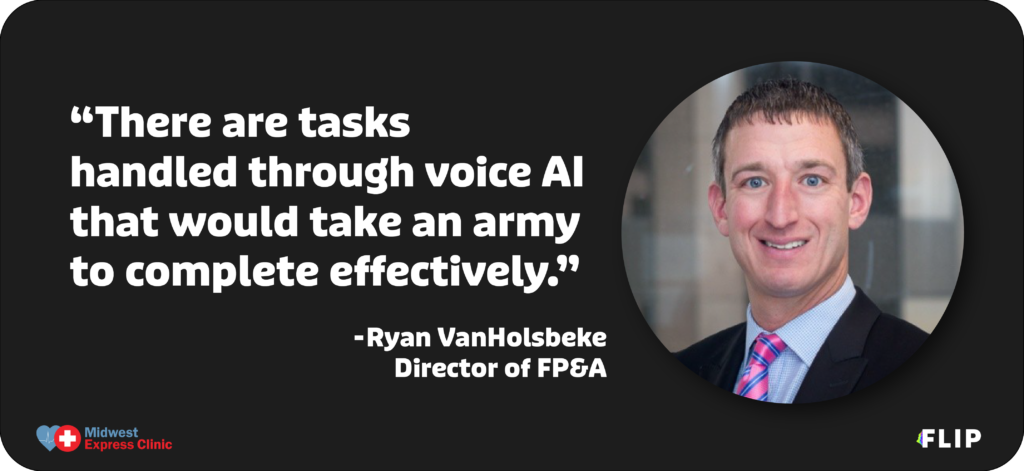
For years, Ryan VanHolsbeke carried around a good idea with no clear path to execution. Now, that idea makes 38,000 calls every six weeks.
Most of those patients were on the right path. Some still needed care. And because someone called, they came back to get it.
Midwest Express is already building what comes next. This time, the vision has the support of a system behind it – and a partner like Flip helping carry it forward.