
- Average automation increase of 28% across regions
- Smart suggestions for repeat callers
- Bookings completed in under 90 seconds
- Voice AI from 0% to 60% in One Day
In transportation, there is no such thing as a low-priority call.
Every phone call is a booking waiting to happen, a customer already in motion, or a decision that needs to be made immediately. Speed matters. Accuracy matters.
For Take Me, a multi-location taxi operator across the UK, voice automation only made sense if it could handle real demand, real passengers, and real operational constraints.
Take Me operates as a collaborative network of local taxi operators, not a single centralized operation. Each fleet runs its own day-to-day business, while relying on shared systems to support scale. Technology at Take Me is built to support daily operations from bookings to call handling without stripping away local knowledge.
Implementing Flip Across the Map
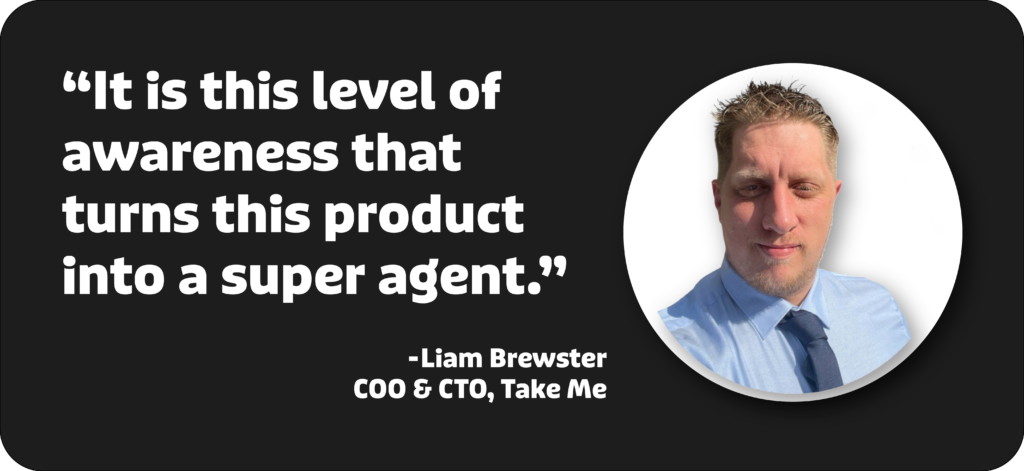
“We rolled out our new Voice AI product across various locations, from our largest operations to our smallest fleets, to see what it could really do,” said Liam Brewster, Chief Operations & Technology Officer.
“And it delivered.”
The results were immediate, and in Malton, the impact was strong enough to surface a new operational constraint – demand outpacing available drivers.
“Automation jumped from 0% IVR usage to 60% on day one, booking away without intervention and even creating the challenge of needing more drivers to meet demand,” Liam said. “Which is a nice problem to have.”
Across the Take Me network, overall automation rose from 45% to 59% at launch, later stabilizing around 57% overall – a 12% uplift that proved especially valuable in regions where local resources were tight.
For Liam, the most important shift was how the system learned from repeat callers and applied that knowledge locally.
“The real game changer is personalization,” he said. “Once it learns about a customer, it starts anticipating their needs.”
Regular passengers no longer had to repeat themselves. The system recognized patterns and adjusted in real time: a feature known as Smart Suggestions.
“When Mrs. Smith calls on a Wednesday, the AI knows she’s heading to ASDA and asks if she wants to book straight away,” Liam explained. “On Fridays, it knows she’s pre-booking to the local social club for 5pm and confirms it without her needing to explain.”
The North West
In the North West, prior automation tools had struggled not because of volume, but because of language.
“While our previous system provided acceptable automation levels, we consistently faced challenges – particularly in Wrexham, where strong Welsh accents sometimes prevented us from utilizing it fully,” said Mike Gittins, Regional Manager for the North West.
Flip changed that dynamic.
“We’ve seen an immediate and substantial increase in automation levels across the board,” Gittins said. “The most significant success has been at our Wrexham site, where Flip AI has excelled and seamlessly handled the previous issues.”
The improvements were measurable across every site:
- Stoke-on-Trent: 47% → 76%
- Crewe: 67% → 84%
- Wrexham: 21% → 59%
Beyond automation rates, the experience itself mattered. The AI’s spoken voice remained clear and natural, even with strong regional accents, and most bookings were completed in under 90 seconds.
“The clarity and realism of the spoken voice of the AI agent is exceptional, helping us maintain a smooth customer experience with most bookings completed in under 1 minute 30 seconds.”
“We’ve also observed a decrease in customers requesting to be removed from the IVR process,” Mike added, “which further validates the positive impact of Flip AI.”
The South West
In Plymouth, the change showed up in daily operations almost immediately.
“Since introducing Flip into our customer call handling, the difference has been great,” said John McVicar, Operations Manager for Plymouth. “It’s already handling 20% of our calls.”
Calls that previously tied up drivers and office staff were answered instantly, giving passengers what they needed without delay and reducing pressure on local teams.
“The AI understands our passengers,” John said. “It handles the most common queries without much fuss, and connects seamlessly to our team when needed.”
The value showed up immediately in day-to-day operations.
“It’s allowed us to provide a faster, friendlier service while freeing up staff to focus on the journeys that matter,” John added.
Regional Success
By rolling out Flip across every location, Take Me showed that voice automation can excel in a distributed taxi network. Automation now supports bookings across regions with different accents, demand patterns, and staffing constraints – completing most calls in under 90 seconds and learning from repeat passengers over time.
For Take Me’s regional teams, the impact has been practical and immediate: fewer routine calls tying up drivers and office staff, faster responses for passengers, and more capacity to focus on the journeys that require human attention.
As Take Me continues to grow its network of local fleets, Flip provides a scalable layer of voice support that adapts region by region – handling demand where it can, and handing off seamlessly when it needs to. In an industry where timing and understanding matter, Take Me has proven that automation can strengthen operations without getting in the way.