

Results felt across front desk operations, revenue cycle teams, and patient access within the first month of going live:
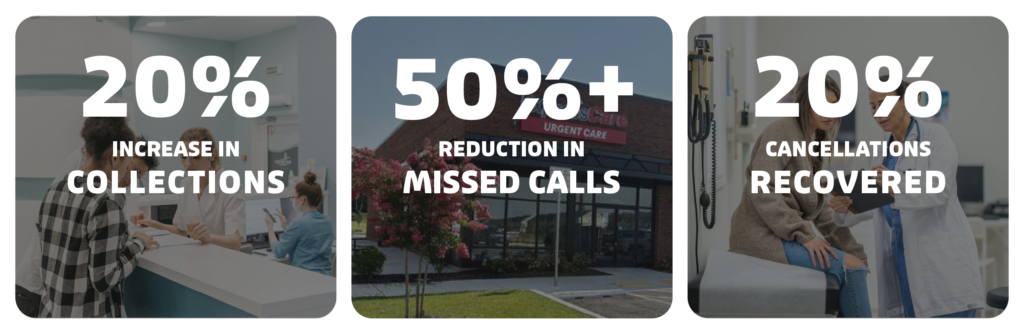
- Missed calls reduced by 50%+
- Patient collections increased 15–20%
- ~70% of phone-scheduled visits resulted in patients arriving
- ~20% of canceled appointments were rebooked and completed
By the time ExpressCare could see the issue with their phone channel, the calls had already happened.
Patients were calling in to make appointments, retrieve lab results, or get urgent advice while deciding whether to seek care. However, inside more than 30 ExpressCare Urgent Care Centers across Maryland, front desk teams were busy checking patients in, answering clinical questions, and managing a constant flow of walk-ins.
The phone constantly rang in the background.
“I don’t know if I recognized how much of a problem it was until we started using Flip,” said Susan Diaz, Director of Front Desk Operations. “Then it was an eye opener to how many patients had been calling that we could have helped right away.”
ExpressCare knew that calls were piling up. What they didn’t know was just how many opportunities for care were slipping past the front desk.
Where The Phone Fell Short
“Before we had Flip, the phone channel was a real drag on resources,” said Steven Fisher, Director of Revenue Cycle Management at ExpressCare. “I had staff who should have been working claims, but they were answering phones. Patients weren’t just calling to make payments. They had simple questions about balances or next steps, and it took up way too much time.”
Calls that required expertise were mixed with calls that simply needed fast answers, and the people answering them were pulled in every direction.
“Patients were getting stuck when calling in while our staff were interacting with patients one on one,” Diaz said. “They were being placed on hold for extended periods of time, even when they had quick questions that could have been answered right away.”
As a result, ExpressCare often had to deflect calls rather than resolve them.
“People calling for hours of operation or wanting to make an appointment were getting directed to the website instead of being assisted at that moment,” said Tracy Boulden, Chief Operating Officer at ExpressCare. “And most of the time, they were not actually going to the website.”
In some cases, patients trying to register for telemedicine or retrieve lab results were left waiting for callbacks. Some never connected at all.
Before making a change, ExpressCare tried to improve call handling using the tools already in place. Calls were routed to different teams, and basic phone trees were introduced to separate payments from balance questions and general inquiries.
“Patients just pressed whatever got them to a person,” Fisher explained. “It ended up taking more and more time.”
The phone continued to absorb staff time that was needed elsewhere. Patient access remained inconsistent, and leadership still lacked clear visibility into call volume, call types, and outcomes. Without reliable insight, it was difficult to understand how much demand was going unmet.
When Flip was first introduced, ExpressCare approached the idea cautiously.
“If you’ve never used something like an AI process before, you do have to take a leap of faith,” Fisher said. “We needed to see the data and understand what would actually happen.”
Confidence came from observation rather than assumption. As call volume shifted away from staff and into automation, the change became visible in reporting and daily workflows.
“Within the first week or so, when we saw the dashboard, I thought ‘There’s no way,’” Boulden said. “But it was all right there.”
Flipping The Script
When Flip reached the front desks, the strength of the system was felt immediately.
“It’s much more manageable now,” Diaz said. “Staff can deal with the patients one on one without the phone ringing constantly in the background.”
The impact was just as noticeable for revenue cycle teams.
“What I was really hoping to get was seeing my staff spend less time on the phone and more time working on accounts,” Fisher said. “I could immediately tell the difference. It also led to better employee satisfaction because constant phone calls can be draining.”
Within a month, the on-the-ground relief translated into real operational results.
“After about two or three weeks, we started getting qualitative feedback from staff,” Fisher said. “After a month, being able to monitor the statistics, we could easily see what was happening.”
Missed calls dropped by at least 50 percent, while patient collections increased by an estimated 15 to 20 percent. At the same time, ExpressCare began capturing visits that previously would have been lost.
“Instead of telling people to go to the website, the appointment gets made right then,” Boulden said. “Nearly 70 percent of the visits generated through the phone actually result in patients arriving. That is a significant difference for us.”
Outbound calls also helped recover cancellations. About 20 percent of canceled appointments were rebooked, with those same patients ultimately coming in for care.
Coverage Without The Constant Pressure
Clearer visibility into call patterns also changed how ExpressCare thought about staffing at the front desk.
“In urgent care, you never really know what the day is going to look like,” Boulden said. “Single coverage at the front desk used to create a lot of anxiety.”
With calls being handled consistently, that uncertainty eased. The phone no longer dictated whether a single staff member could manage the desk.
“Now we know somebody is always answering the phone,” Boulden said.
That reliability allowed ExpressCare to adjust staffing without compromising access. As staffing shifted or positions opened, coverage decisions were no longer driven solely by the need to keep the phone manned.
“It has helped us on the staffing side as well,” Diaz said. “We can focus on the people who are in front of us without feeling like we are letting someone else down.”
For front desk teams, the impact showed up in the quality of each interaction.
“You are able to give the patient who is physically in the clinic your full attention,” Diaz said. “And the person calling in still gets what they need.”
The Role Of The Phone In The Patient Experience
For ExpressCare, the phone remains one of the clearest expressions of patient experience.
“Customer service is what brings patients back,” Diaz said. “They can go anywhere for urgent care. Being able to easily make an appointment and get directed quickly is what makes the experience so seamless.”
By rebuilding how calls are handled, ExpressCare strengthened its ability to meet patients where they are, ensuring that when patients reach out, someone is there to guide them.
The result is quieter phones, steadier clinics, and a clearer path into care.