
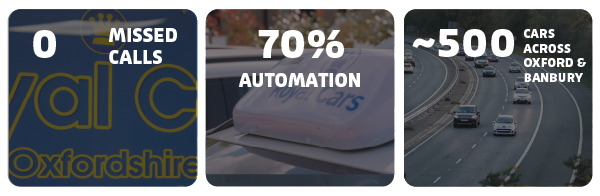
- ~70% of call volume handled by Voice AI
- Missed calls dropped to zero
- Implementation timeline working from day one
- Fleet size ~500 cars across Oxford and Banbury
How Do Transportation Companies Replace a Legacy Call Center?
Royal Cars’ story began in 1992. Managing Director Qasim Mohammed remembers growing up as his father started and built the business. He would watch dispatchers coordinate bookings over radio systems and scribble jobs onto scraps of paper, before eventually answering phones himself as a teenager.
“When I was 13 or 14, I was taking calls,” he recalls. “By 18, my cousin and I were still out delivering leaflets around Oxford trying to win new customers.”
When he returned from university in 2010, his father gave him a choice: sell the company, or take it to the next stage. He chose growth, and bet on new technology at each stage: apps, IVR, and now Flip and Voice AI, in partnership with iCabbi.
How Can Taxi Companies Handle High Call Volume Spikes?
At Royal Cars, operators used to compete over how many calls they could take in a shift. 500 or more was normal.
“You’d speak to operators on telephones now and speak to them about taking 500 calls in a six-hour shift,” he says. “It’s unimaginable.”
The real problem wasn’t the volume on a normal day. It was what happened when things went sideways. A sudden change in weather, a burst of demand, and the queue would explode. Customers calling in could be waiting 30 seconds or 10 minutes with no way to know which. Management and admin staff would get pulled onto the phones just to keep up. Call handlers rushed bookings and made more mistakes. Customers with genuinely complicated requests were the ones most likely to get brushed off in the crush.
That was the challenge Royal Cars was managing when Flip came along in 2023.
“The idea of your customers engaging with a robot, I was a bit uncomfortable with,” Qasim admits. “I thought a lot of my customers wouldn’t like it. They liked the human element of speaking to an agent.”
So Flip proposed a free one-week trial: take it, and if you like it, keep it; if you don’t, you’ve lost nothing. That low-pressure, no-strings approach was what got Royal Cars to actually flip the switch.
“The moment I switched it on, I came to a very quick realization that this is the way forward. This is the future.”
Once the decision was made, the technical rollout was, by his account, remarkably smooth. His team worked directly with Flip’s team, communication was easy, and the impact was visible from day one. The AI system absorbed the repetitive, low-complexity work, freeing up the agents who remained to focus on calls that actually needed a person.
Can Voice AI Automate Calls End-to-End Without a Human Handoff?
The most immediate, measurable shift was missed calls, which disappeared.
Every call was either answered by the AI system instantly or routed to a live agent, with no hold, no queue, and no chance of a customer giving up and calling a competitor instead. Response times on bookings improved. Communication improved.
One specific feature stood out for Qasim above the rest. Royal Cars configured Flip to automatically follow up on any booking that had gone 20 minutes without a driver being assigned or any engagement from the customer. Flip Voice AI calls the customer back, confirms whether they still need the ride, and logs the outcome directly on the booking. If the customer wants a car, dispatch knows to keep working it. If not, the booking closes out cleanly instead of quietly dying in the system.
The effect on the business has been concrete: fewer cancellations, fewer no-shows, and more confidence on both ends of the transaction. Passengers know their booking hasn’t been forgotten. Drivers get a notification confirming the ride is real before they head to the pickup. The Managing Director says this has made drivers more willing to take the job, which has increased driver revenue.
What Are the Tradeoffs of Voice AI vs. Human Agents in a Call Center?
None of this replaced the phone as a channel. If anything, it clarified what the phone is actually for.
Royal Cars still relies on live agents for bookings that don’t fit neatly into an app or an automated flow: elderly passengers who want to talk to a person, large group and minibus bookings with specific requirements, airport transfers that need a child seat, school transportation accounts, and particularly complex needs. “Those types of queries will come through the phone.”
The difference now is that staff answering those calls aren’t also fielding hundreds of routine requests in the same shift. Dispatch and call center staff, Qasim says, have more time to actually solve problems: the lost bag in a car, the student left behind after a driver mix-up, the passenger whose parents aren’t answering the door, the driver stuck at the airport with a delayed flight. Those are the calls that need a human, and now the humans have room to handle them well. The result, in his words, is “a better workforce and a happier workforce.”
How Long Does It Take to Get Set Up with Flip?
When asked what surprised him most, Qasim Mohammed doesn’t point to a number. He points to speed.
“I thought it was going to take a lot longer than it did,” he says. “It worked from day one.”
His biggest fear going in was that the AI would sound stiff or repetitive: that customers would immediately clock it as a robot and disengage. Instead, he found it more engaging than expected, capable of handling a wide range of queries without losing what he calls “that human element.”
Is Multilingual Voice AI the Next Step for Transportation Companies?
Royal Cars operates in Oxford, a city that draws a large number of international visitors every year. The Managing Director is already thinking about the next evolution of the system: multilingual support. That, he says, “has huge potential here in Oxford and around the UK.”
What Are Transportation Companies Saying About Switching to Flip?
For someone who grew up watching his father run this business off a radio and a notepad, the current moment isn’t lost on him.
“Sometimes when I look back from where we started and where we are today, it’s like a pinch-me moment,” Mohammed says. “You think to yourself, wow, how did I get here?”
He’s quick to credit the partners who helped get Royal Cars there, Flip among them, rather than framing it as a solo achievement. The through-line is clear: a family business built on hard work and a willingness to bet on technology before it was comfortable to do so, now running a fleet of roughly 500 cars across Oxford and Banbury with automation levels near 70%, fewer missed calls, fewer cancellations, and a call center that, for the first time in its history, is actually quiet.
His advice to any operator considering the same leap: “Get in touch with the guys, go for a little trial, and I’m pretty confident it’ll work for your business.”
In Summary
What automation rate did Royal Cars achieve with Flip’s Voice AI?
Royal Cars automated nearly 70% of their call volume using Flip and Voice AI, in partnership with iCabbi. Every call is now either answered instantly by the AI or routed to a live agent with no hold queue.
How did Flip impact missed calls at Royal Cars?
Missed calls dropped to zero. Once Flip went live, every incoming call was answered immediately. No customer waited on hold without a response, and no one abandoned the call to reach a competitor instead.
How quickly does Flip’s Voice AI go live?
Royal Cars’ implementation worked from day one. Managing Director Qasim Mohammed says: “I thought it was going to take a lot longer than it did. It worked from day one.”