
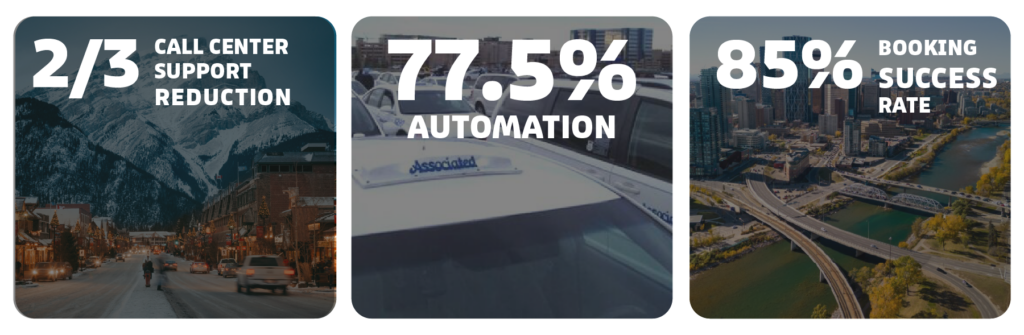
- 77.5% inbound call automation within the first three weeks of going live
- Up to 90% automation on Associated Cab’s busiest days
- ~85% booking success rate across automated calls
- 2/3 reduction in outsourced call center coverage within two weeks
Jeff Garland has seen just about everything the transportation industry has to offer.
He joined Associated Cab Calgary in 1981, when the company still ran wind-up meters and dispatched drivers over two-way radio. He watched the first computerized dispatch systems come online in the early ’80s, primitive by today’s standards, but revolutionary at the time. He navigated the disruption that was the rideshare revolution. He managed a fleet that, at its peak, ran 700 cars across Calgary, Alberta.
After 45 years in the business, Garland doesn’t get impressed easily.
Which makes what happened in the first two to three weeks after Associated Cab deployed iCabbi’s Voice AI, powered by Flip, all the more striking.
THE PROBLEM WITH PEAKS
Running a cab company in Calgary is defined by a variety of peaks.
The city’s weather is punishing – major snowstorms send call volume through the roof, with hundreds of riders suddenly needing a car at the same time. Then there’s the Calgary Stampede, the legendary 11-day rodeo and festival held every July that draws over a million visitors through the gates. And six weeks out from Christmas, corporate party season kicks in and doesn’t let up until New Year’s.
For each of these peaks, Associated Cab faced the same equation: staff up to handle the surge, or miss the calls.
“The Voice AI can answer multiple lines all at the same time,” Garland explains. “If you’re in some of those situations, you would have to have 10 or 12 operators to make sure you don’t miss any calls. On some of those days, we’d have missed calls in the hundreds.”
To manage the load, Associated Cab had outsourced nearly half of their call center operations to a team in the Philippines – agents working 24 hours a day just to keep pace. It worked, but between the expense and the quality variability, it was fundamentally a patch on a structural problem.
Garland started looking for something better.
“THERE’S NO OTHER WAY TO GO”
The decision to move forward with Flip wasn’t a leap of faith, it was due diligence. Garland spoke to colleagues in the industry who were already using the platform and heard good things. Then, he ran the numbers himself.
“You figure out what the cost is versus what you can save,” he said. “There’s no other way to go really, if you’re looking for something that’s efficient and cost effective and moving forward.”
Onboarding was handled by the Flip team and, by Garland’s account, was about as smooth as these things get. Communication was direct, and if something wasn’t working right, Garland flagged it and it got fixed. There weren’t many flags.
The real work of setup was building the location intelligence that would make Flip genuinely useful for Calgary riders.
Hotels, hospitals, shopping centers with ten or fifteen different entrances all had to be configured with precision. When a customer called from Chinook Centre or Foothills Medical Centre, Flip needed to confirm exactly where they were standing. Getting that wrong would not just be an inconvenience, it would mean a failed trip.
The airport configuration added another layer. As pickup and drop-off fees have become standard at most major airports, Flip was set up to proactively disclose those charges the moment someone books a ride to YYC. Same goes for specialty vehicles: if a caller requests a van, the additional charge is communicated upfront, before the booking is confirmed.
“I think it helps just to tell people right up front,” Garland said, “so they know what to expect.”
TWO WEEKS TO RESULTS
The results arrived faster than Garland anticipated.
Within two to three weeks of going live, Associated Cab had reached 77.5% inbound call automation. On their best days, that number has climbed toward 90%. Their booking success rate sits around 85%. And the operational footprint of their call center has been dramatically restructured: where they once relied on a large outsourced team around the clock, they now run two to three people in-house for most shifts, with a single outsourced operator covering overnight.
“It was only a week or two after we put AI in that I cut out two-thirds of the outsourcing,” Garland said.
That’s not just a staffing change, but a structural one. Associated Cab no longer needs to solve the peak problem by throwing headcount at it. When a snowstorm hits Calgary and causes call volume spikes, Flip absorbs the surge. The missed calls that used to number in the hundreds are now, on a typical day, down to two or three hangups.
Not everything about deploying Voice AI is frictionless, and Garland is candid about that. Some customers took time to adjust. A few weren’t sure they were talking to a computer at all.
That being said, the customer response has been positive. A meaningful segment of riders actively prefers it: the ability to book a cab without waiting on hold or talking to anyone resonates particularly well with younger customers and frequent riders.
“As AI grows,” Garland reflects, “and people start using it more, I think they’ll get used to it and it’ll be a different experience down the road.”
Day-to-day, the system requires almost nothing from his team. “You just turn it on once in a while to look at the stats,” he said. “There’s not much you have to do.” The flexibility is there when needed, whether that means adjusting announcements or toggling features. The lift is minimal.
“WHAT HAVE YOU BEEN WAITING FOR”
Associated Cab isn’t done. The limo division, an 80-car fleet, is next in line for automation. Garland expects the impact there to look different: limo bookings are more complex, often managed via email and requiring detailed coordination. But for the straightforward point-A-to-point-B calls that come in during peak times, Flip can take those off the operators’ plates and keep customers from sitting on hold while the team handles something more involved.
The Stampede is also on the horizon. This July will be the first true stress test: a million visitors, eleven days, and Flip handling the phones. Associated Cab is excited.
When Garland talks to other operators about iCabbi’s Voice AI, powered by Flip, he doesn’t dress it up.
“What have you been waiting for?” he tells them. It’s the honest answer from someone who spent decades managing call volume the hard way, with outsourcing, staffing up, and absorbing the missed calls. He has already introduced Flip to colleagues across Calgary. Today, three cab companies in the area are on the platform.
Garland is planning to retire at the end of 2028, 48 years after he first climbed into a cab to help pay for university. He’s seen the industry transform more times than most people would believe. The emergence of AI, he says, is just the latest chapter, but it is one he is glad Associated Cab did not sit out.
For Garland, the math is simple. Voice AI is not a novelty. After nearly five decades of managing call volume the hard way, it is the next practical step.
“At the end of the day,” he said, “it’s a no-brainer going forward with efficiency in the business.”